When was the last time you connected with yourself creatively?
In case you missed the announcement here on the blog last week, my second book is coming out on October 27th! (It’s been such a long time coming that typing that feels surreal. I’m so excited!!)
The book is called Human Leadership: The Courage to Face Ourselves and Each Other, and writing it cracked me wide open like nothing before. It feels like I’ve grown more in the last year as a result of writing this book than at any other time in my life—which, if you’re familiar with my first book, is saying something.
Throughout the process, I kept a running list of the most powerful lessons I learned so that I could share them with you. They aren’t necessarily about writing, though if you’re working on a book of your own or want to write one in the future, they may help. More than story structure or word choice, bringing this book into the world taught me about life, leadership, and beyond.
It felt excruciating to keep these learnings a secret for the better part of a year, especially because they were so transformative for me. That’s why I’m so flipping excited that I can finally share them with you!
To kick off this series (which will run through October 27th—pub day!), I want to take you back to the night that changed everything for me when it came to writing this book.
I call it my inflection point.
Allow me to set the scene. . . .
It was a cold, rainy night in early January. I hadn’t yet returned to work, and the world around me was still in a holiday bubble after ringing in 2026.
After a slow start in the fall, I’d envisioned that I’d spend the holiday break making a lot of progress on writing the first draft of my manuscript. But so far, that hadn’t happened, and I was feeling down on myself. Having a book deadline is like having a major homework assignment: No matter what you’re doing, it’s always looming in the back of your mind.
By early January, I’d drafted just 30 or 40 pages. While I wasn’t yet sure how long my book would be, I knew that what I’d written so far was a drop in the bucket. I had hundreds of pages left to write and not much time to write them because my editor was expecting a complete first draft by April. I had to get moving.
So on this quiet, wet night, I sat in my office staring at my computer, hoping that the words would come to me.
I couldn't understand why I hadn’t made more progress. I’d spent so much time writing and rewriting the proposal for this book that I was so clear on my vision for what it would be about. I’d already outlined every chapter and plotted out every takeaway, so logically, I knew exactly where I was going. And yet, I was struggling to get something down on the page. I wasn’t feeling as inspired or motivated as I thought I’d be. Worst of all, I felt like I’d lost the connection to the book I’d had when I was first dreaming it up. I was still excited about writing it, but my book spark was dim. I’d lost track of how many days I’d opened my laptop with the intention of writing but gone to bed without a single new word written.
As I watched the rain trickling down my window, I had an idea.
Just a few months earlier, Monique, our Chief of Growth and my thought partner, had flown to Houston to help me map out content for a different project. While we brainstormed, Monique suggested that we write down our ideas on Post-Its and stick them to the wall. By the time we were finished, we’d used up several packs of Post-Its, and there was a whole new offering laid out in my living room. Using the colorful, sticky little squares had made the process feel fun and energizing, and I think it helped us both be more creative.
What if I did something similar for the book? I thought.
I grabbed my phone and opened up UberEats—my weakness. I ordered a ton of Post-Its, dozens of pieces of posterboard, and a pack of the brightest, most colorful markers I could find.
As I waited for my supplies to arrive, I made myself a snack board, lit a candle in my office, dimmed the lights, and turned up my favorite playlist—very important steps for getting in the zone.
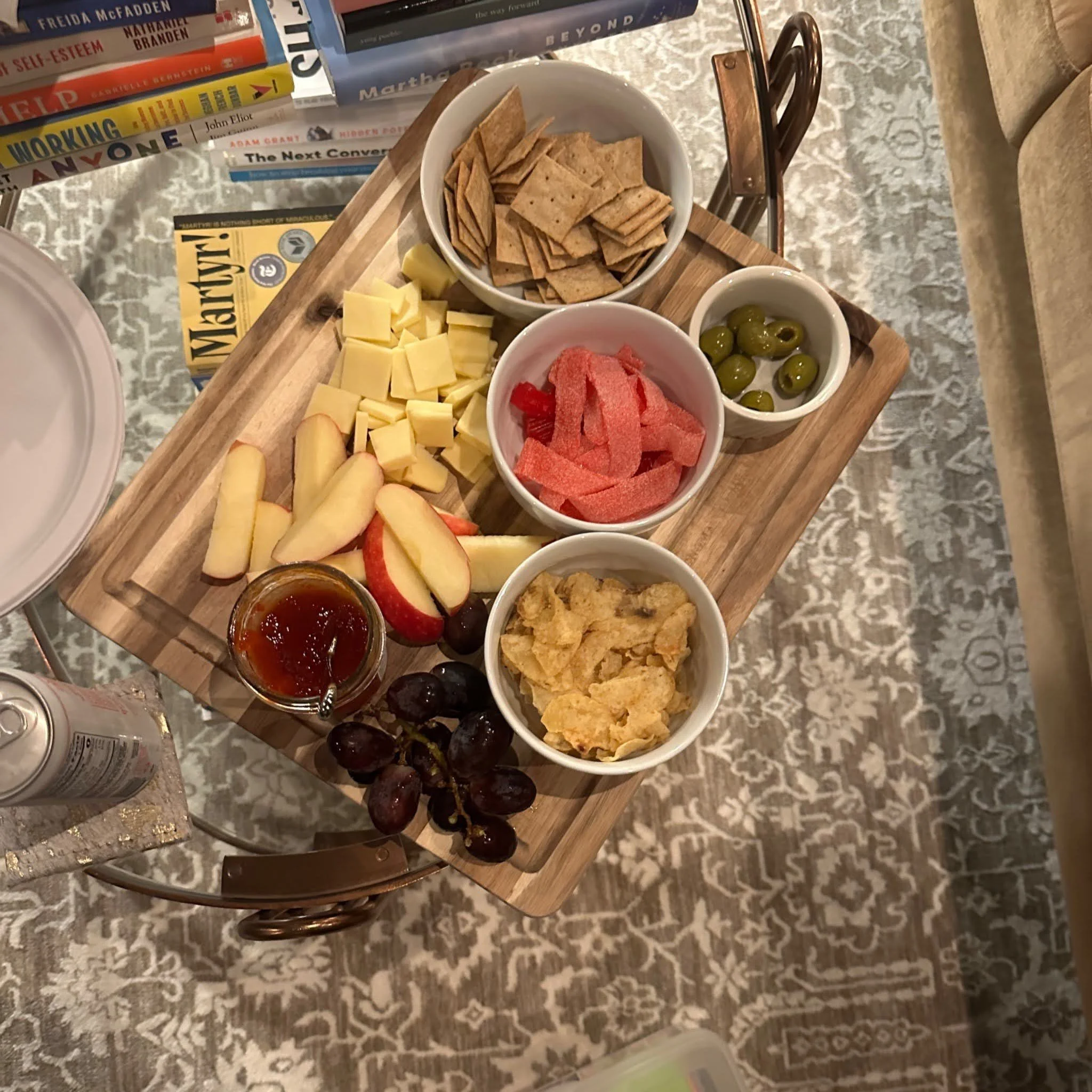
Thirty minutes later, I was ripping plastic wrap off posterboard and laying the sheets around the perimeter of my office.
Good start, I thought, but the blank posters were reminding me too much of my empty Word doc. I needed some inspiration.
That’s when I remembered the running note I keep on my phone for moments like this. It’s full of writing advice from authors and thought leaders that I collect from podcasts, articles, and even other books.
I pulled up the note and scrolled down until I saw what I was looking for: a collection of big, overarching questions to consider when writing a book. Most of them came from Steven Pressfield’s Nobody Wants to Read Your Sh*t, the Writer’s Routinepodcast by Dan Simpson, and the Fiction Writing Made Easy with Savannah Gilbopodcast.
I decided to write some of my favorite questions along with a few of my own at the top of each posterboard. Here they are:
Who am I writing this book for? Who are the specific people who come to mind?
How do I want readers to feel when they read this book?
What does the protagonist (that’s me) want? What is their internal struggle? What is the arc of that transformation? Who will they be at the end?
What is the theme of the book and what might be underneath it? What question does it answer? What do I want the reader to think about?
What is the central problem? What is at stake? What does resolution of the problem look like?
What is the climax of the book? The point of no return?
What do readers expect for this genre? What promises need to be made and how will I keep those promises?
After that, I laid out an additional posterboard for every chapter in the book. Soon my wood floors would be almost completely hidden by sheets of paper.
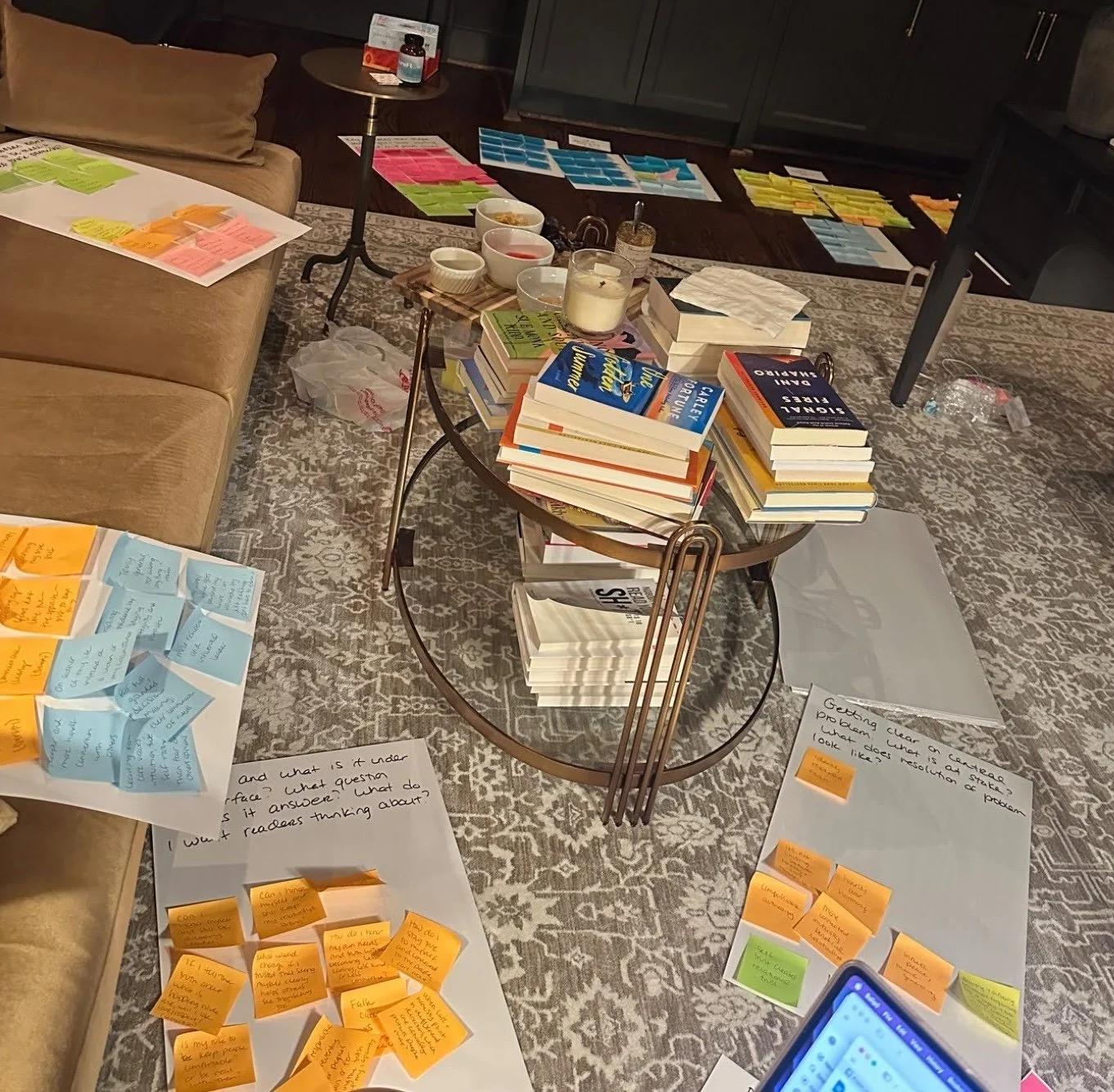
And then . . . something happened.
With these questions and chapters laid out before me, I started to think about the book in ways I hadn’t before. Almost immediately, new ideas began to pop into my head, and I captured them as quickly as I could and stuck them to their respective boards. I even thought of pulling out old journals and reading through entries that referenced the stories I wanted to share so that I could remember exactly how I felt at the time.
Once the ideas started coming, I couldn’t stop them. Soon, each chapter had several posterboards, and each one was completely covered in bright neon squares.
When I finally looked at my phone to check the time, it was after 2 a.m., but I didn’t want to stop. So I didn’t. In the end, I spent more than seven hours covering my office floor in posters and Post-Its.
Thinking back on that night now, it’s hard to describe exactly how lit up I felt. I was in a sublime state of flow I’d never experienced before, and it made me feel so connected to the work I was doing. My intuition knew exactly what to put on each Post-It and where it should go, so I just followed it until the steady stream of ideas slowed to a trickle.
That night changed the trajectory of my book. The ideas that came to me were nowhere in my proposal, but every single one ended up in the finished manuscript. I swear, they came straight from my heart—the only place they could have come from. The huge steps forward I took that night were the reason I turned in a complete first draft four months later.
But my brainstorming session didn’t just kick-start my creativity. It ignited something in me.
Working with my hands and writing things down on paper made me feel alive. It made me feel connected to myself creatively in a way I’d forgotten about. It made me hungry to bring this project to life in its fullest, most authentic form.
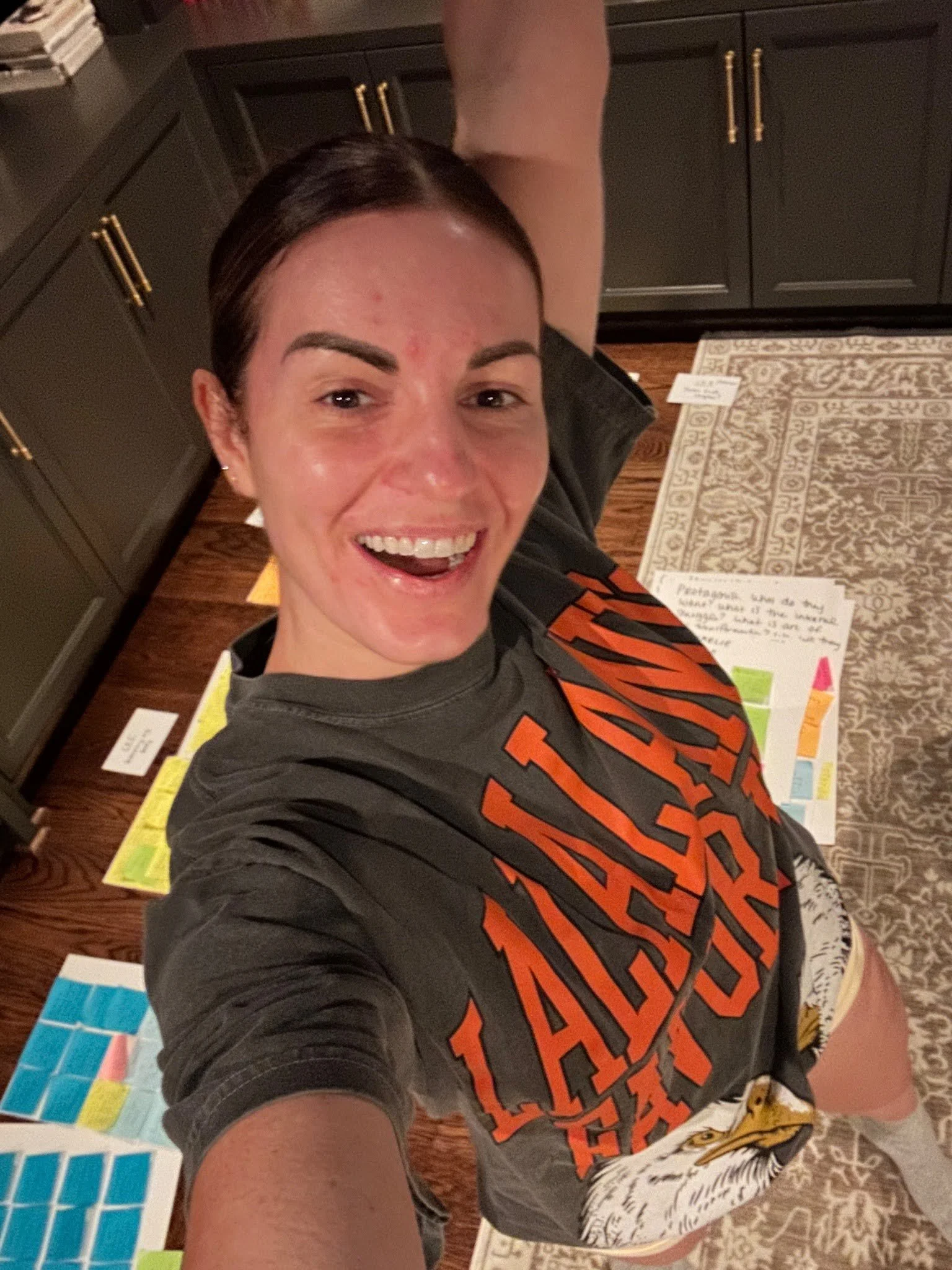
I snapped this selfie to remember how alive I felt that night. It makes me so happy to look at it!
And to think, it all started with staring at my laptop and feeling stuck.
So why am I telling you this story?
Sure, maybe you can use this process and the questions above to map out a book if writing one is something you want to do.
But this isn’t really about the book. It’s about connecting to our creativity and our higher purpose.
What I realized that night is that so many things get in the way of that connection. The things we’ve come to rely on—our phones, our laptops, the internet, even AI—make it so that we never have to be alone with our thoughts if we don’t want to be. There’s always a way to fill our time with distraction.
I want to encourage you to think about how long it’s been since you connected with yourself in a way that made you feel alive. When is the last time you let your mind wander? How long has it been since you brainstormed without a screen in front of you? When did you last write something by hand instead of typing it? Have you ever used art or office supplies to map out a dream? What could happen if you gave yourself permission to create what’s in your heart?
This special night showed me that the words I was waiting for were inside of me all along. I just needed to listen.
And maybe that’s what your heart is asking you to do, too 🧡
Wow, my friends. It feels exhilarating to share these behind-the-scenes moments with you. I hope that pulling back the curtain on this process and what it’s taught me has inspired you in some way and that it will continue to inspire you in the weeks to come.
What did this post spark for you? What did it make you think about? What might you do—or not do—because of it? If you felt a tug in your heart as you read, what do you think that tug is trying to tell you? Please take a moment to reply and let me know your answers. My team and I love hearing from you, and your responses will help me continue to share my learnings in the most impactful way possible.
I can’t wait to see you back here next week for the next one!
(And in the meantime, if you haven’t pre-ordered the book, your support would mean the world to me.)
Big hugs,