What would happen if you sought out the support you desired and deserved?
When you think about someone writing a book, you might picture a person sitting alone, typing away at a computer. Before I wrote one myself, that’s what I always thought it would be like.
And it is—a lot of the time. But while there might be one name on its cover, a book is too big of a project for someone to tackle alone.
I’m really proud of the way I sought out support for my second book. My team was a huge part of it, of course, but I also looked beyond them and even beyond the typical roles authors might ask others to fill. What I found was unconventional and unlike anything I’ve done before.
I want to show you what that support looked like and introduce you to the people who helped me take my book from a collection of ideas in my mind to the manuscript that will hit shelves on October 27th. I hope that it shows you the power of asking for help and working with people who truly see you for you.
I first learned about the kind of support it takes to publish a book when I wrote my first one, Permission to Screw Up. When I got my book deal, I had a misconception that I wouldn’t need to look for any additional help. I already had my own team supporting me, and I thought that working with a publisher meant that their team would also play a major role in bringing the book to life.
As it turns out, it’s not that simple.
Now, don’t get me wrong: A publisher will help with editing, marketing, PR, design—the list goes on. And all of it helps. But they may not be able to provide you with the exact support you need in all of these areas.
This isn’t a dig at any publisher. If you think about it, publishing houses produce several books at a time, so their attention is spread across several authors—as it should be. But in writing my first book, I quickly realized that I needed a more regular and intimate level of creative support than the publisher’s team could provide. I also wanted to work with people who weren’t as close to the project as my own team and who would challenge my ideas and push me to make them better.
When I wrote Permission to Screw Up, I hired two outside helpers: One person was very hands-on in the editing process, and the other was more of a project manager who helped us set the direction for the book and stay on track for our deadlines, in addition to helping with edits. But when it came to writing this book, I knew I needed something completely different. I needed a space for me.
Since our very first meeting in 2021, my team had been in nearly every conversation about my second book. Later on, if it wasn’t my team, it was my publisher. I loved being able to talk through my ideas with them, but I found myself craving a place where I could share my messy and human thoughts and make sense of them before inviting my team and publisher into them. I wanted to get clear on my own ideas and have a point of view I felt certain about before asking those closest to the story to weigh in. I also craved a space where I could vulnerably share the experience of writing a book and all the emotions that come along with it. Most of all, I desired conversations where I could talk about this project as something much bigger than a book. Because to me, it was.
I consider this book to be my art. It’s my self-expression. It’s my creativity. It’s a part of my life’s work and impact. This 304-page manuscript isn’t just about me; it is me.
And that’s why my therapist became my first source of external support.
If you’ve been here for a bit, you know how obsessed I am with therapy. My therapist and I meet at least twice a month for a “walk-and-talk,” where we talk on the phone while I walk.
As I started working on the second book, I noticed that our conversations were becoming less about life and work challenges and more about the book. It started with telling my therapist how afraid I was to be so vulnerable in my writing. Early on, I’d decided that I was going to put it all out there in this book, but it was often a choice I second-guessed. Many of our chats centered on my fear of judgment and what people would think of me once they read the stories in the book. There were even times when I told my therapist that I wanted to write the book only for myself and never actually publish it because of how deep that fear ran in me. By the end of each call, she helped me come back to myself. She helped me remember why the fear was so worth it. That sometimes to make the impact you want to have, it requires courage and taking a risk.
I’m sure most people don’t think of therapy as a space to help you figure out how to structure your book, but that’s also what happened for me. When I thought about the truest form of my creative expression, I imagined a book with dozens and dozens of short chapters. I love reading books like that, but I had so many limiting beliefs telling me that I couldn’t do it. This was a leadership book, not fiction, so I needed to stick to the genre and what readers are used to, right? In one call, my therapist helped me see that I needed to trust my reader and write the book that I would want to read. So that’s what I did.
My walk-and-talks with my therapist became integral to my writing process. We kept up our twice-monthly calls throughout, and when my doubt and fear crept in, we ramped them up to weekly and sometimes even twice a week.
My therapist wasn’t the only one who offered me a unique level of support throughout this process.
Another came from a friend I’ve known for years who is an incredible writer. Her name is Bryn, and every time I read her work, it moves me to chills, or tears, or both. One of her gifts is her willingness to be vulnerable, and it makes others—including me—feel seen. I would read her posts and think, Wow, I wish Bryn could help me with my book. I wish she could help me reach that same level of vulnerability. And then one day, I thought, Well, why can’t she?
One evening before a speech, I sent Bryn a voice note with an idea: While I didn’t really have a clear plan for how we could work together, I knew that I wanted her creative thought-partnership on my book if that idea excited her. She was immediately game.
Bryn and I formed such a special connection, and it fed into a beautiful and impactful collaboration. She helped me talk through the stories I wanted to tell and take them to the most vulnerable level I could. She would ask, Why did that happen? What was underneath that? How did you REALLY feel when that happened? Before I knew it, I was bearing my heart on the page in a way I never had before.
Bryn was often the first to read my writing when I started the book. She would point to the places where she could sense I had more to say, and she would challenge me to go there. When I described something as feeling “good,” she encouraged me to reach for a deeper feeling. When I told a story that made me angry, she helped me capture my rage. Throughout the writing process, she helped me stay true to my overarching goal: To write the truest and most authentic book I possibly could. She never gave me the answers. She only pointed me back to myself.
In addition to Bryn and my therapist, there were so many other special people who helped me.
To bring to life the cover I saw in my dreams, I hired an artist (Isabel!). I knew the art department at my publishing house was working on multiple covers at a time and could only do so many revisions. I wanted a space where I wouldn’t feel limited and could really run with my ideas until I landed on the one. Any time I see the cover today, it makes me so, so happy because I know it’s exactly what my heart wanted.
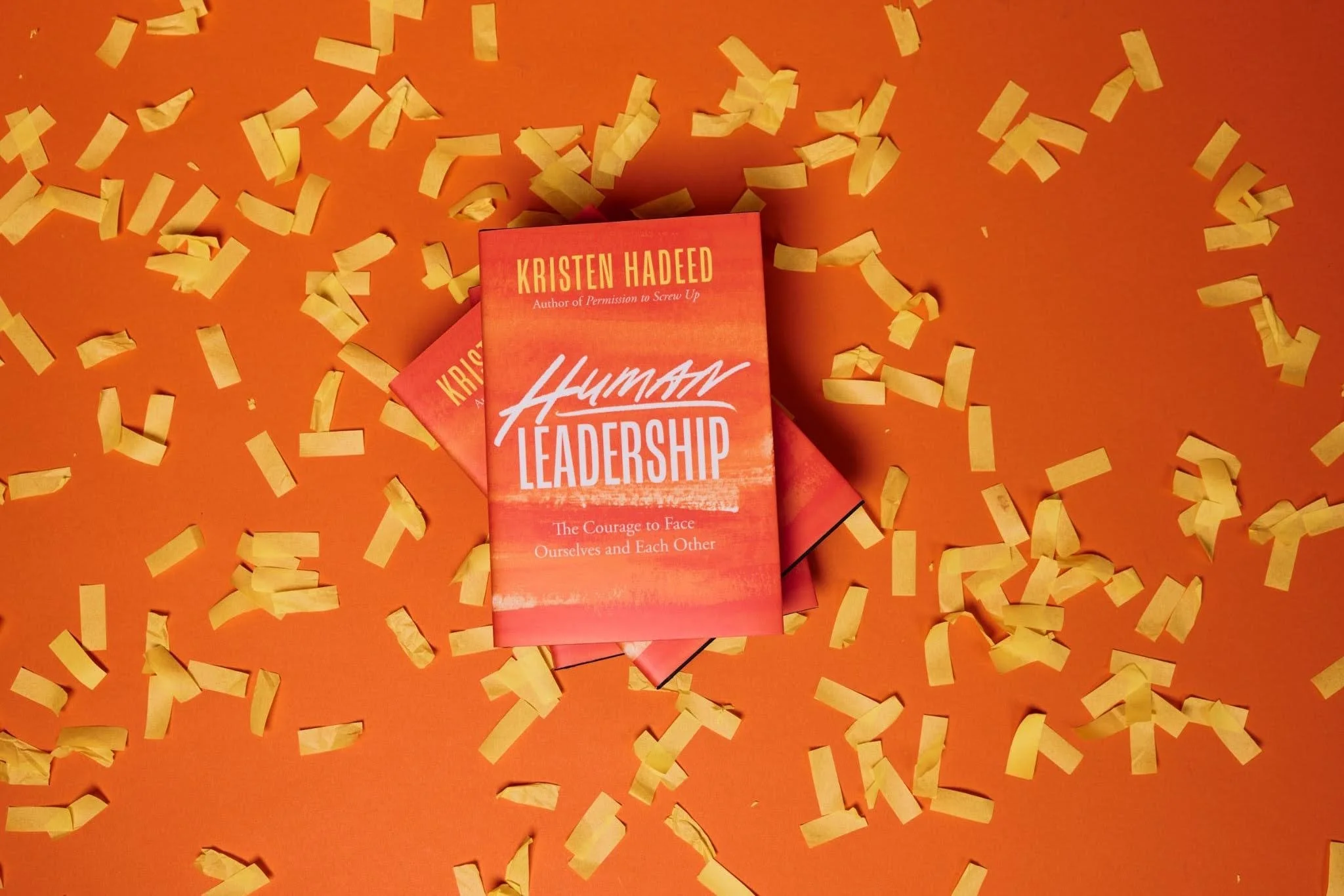
To help me brainstorm the title and strategic positioning of the book, I hired a PR company. I thought about choosing a title that was more “fun” or “edgy” and that matched the Permission to Screw Up brand, but what my heart really wanted was something simple and powerful. The PR company helped me come up with some solid options, but we knew we hadn’t landed on “the one” yet. Then one night, I was looking at an old draft of the manuscript that had a placeholder title on the cover: Human Leadership. There it was, right in front of me. I knew that’s what I wanted to call it, but I doubted it could be that simple. Normally, I would’ve ruminated over that decision for days or weeks, but instead, I called up the PR company and asked for their advice. They advised me that calling the book Human Leadership would signal a bold new era for me and the business. It would give me the opportunity to define a leadership term instead of following the cheeky style I had in the past. In a way, it felt like growing up. When I heard their feedback, I knew in my gut that Human Leadership was it.
My friendships were also sources of support. One friend met with me several times to brainstorm titles before I chose Human Leadership, and once I had, we moved our focus to subtitles. She’s so good with words and extracting what is already inside of someone, and that’s what she did for me. When we landed on the subtitle, The Courage to Face Ourselves and Each Other, at the end of our second meeting, I just knew that was it. It felt like magic. I even bought us matching bracelets so we’d remember that day forever. Other friends read early chapters and gave me their honest feedback. One told me, “Don’t you dare change a word,” after she read, and it inspired me to keep writing with vulnerability despite my fear.
The thing is that none of these people are who I expected to be on my book team. In the beginning, I didn’t really know what kind of help I would need, so I just listened to myself. When I felt a need or desire for something, I followed it. In many ways, that’s one of the biggest messages in my book. I’m proud that I walked my talk even while writing it.
What I realize now is that I sought out these people because I knew they had strengths that I didn’t, and I thought they could help me stay true to myself. While my team and publisher were a huge part of my book team—perhaps the biggest—I believe that our work together was only as successful as it was because I had all of this external support. I think they would tell you the same.
Even when a project is deeply personal and close to your heart, you don’t have to do it alone. And in fact, I would argue that we shouldn’t. Sometimes, we’re too close to a project. We need someone else to hold up the mirror and help us see what we can’t. Someone who knows where we want to go and can help guide us back when we veer off-course. Someone who can bring us back home to ourselves. Without these people, this book would not be what it is. And if I never had the courage to ask for that support, I might still be stuck on the first draft of my manuscript instead of writing this blog post to you.
How about you? When is the last time you sought out the support you really needed? When is the last time you made a bold ask of someone when you weren’t sure they’d say yes? What would happen if you sought out the support you desired and deserved? I’d love to know what this post makes you think about. Hit “reply” and tell me and my team all about it! We absolutely love reading your responses.
As for me, I’m continuing to learn to ask for the support I need. In case you missed it last week, I announced that for the first time ever, I will have an official Launch Team to support me and my team in introducing Human Leadership to the world.
If you haven’t joined yet, I’d love for you to be a part of it.
In the past, when people asked me what they could do to help with the book launch, I tended to downplay it and said I didn’t need anything. But you know what? It’s a lot of work to launch a book, and my team and I do need your help!
After pouring my heart and soul into this idea for the last several years, my greatest wish is that it makes the kind of difference in the world that I always hoped it would. To do that, we need a team to spread the message!
Being part of the official Human Leadership Launch Team means signing up to help us spread the word about the book to your network and beyond. When you join, you’ll get an invite to an exclusive Facebook group where we’ll share regular updates on the most impactful places you can share posts and reviews. We’ll keep it as simple as possible because we know you’re busy! In return, we’ll show our thanks by giving you exclusive bonuses only available to our Launch Team, including early chapters for reading (available as soon as you sign up), a reflection and discussion guide, a live, virtual Q&A with me about the book, and even access to a digital version of the entire manuscript two weeks before official publication! To join, pre-order the book from any retailer and enter your order number on the form on our Launch Team website. After that, we’ll email you with next steps.
I hope you’ll join us and that we’ll be seeing much more of each other over the next several weeks!
And if the Launch Team isn’t for you, that’s totally okay, too. Either way, I’m so glad you’re here! Your messages of support and celebration about this book have meant the absolute world to me and my team.
See you here next week for another book lesson!
Big hugs,